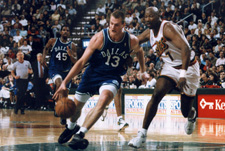
 Van Taylor (Sonics Player Rushes For Basketball) 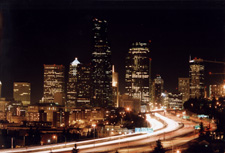 The Seattle Skyline, from Dearborne Street Overpass 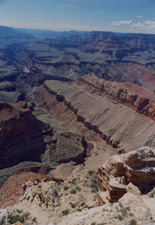 The Grand Canyon |
Official Publication of Photo Marketing Association International May, 99 Issue, (Pages: 58-59) By: Larry Thall While the autofocus capability of modern 35mm camera is a great convenience to many photographers, it's a necessity for Robert D. Wright, Seattle, Wash. "I first heard about autofocus cameras in 1987, from a man who worked as a salesman for Eastman Kodak Co., " Wright remembers. "My ears perked up the second I heard the word autofocus, for I never knew such a technology existed." Wright is legally blind, the result of an auto accident he was involved in at the tender age of 16 days. His injuries caused permanent brain damage, which also left him largely disabled on the right side of his body. With his better eye -- the left one - he's able to discern light, color, shapes, and movements, but nothing is in sharp focus when looking through the viewfinder. Autofocus technology overcomes what otherwise would be an insurmountable barrier. Wright first experimented with photography in 1974, using a Yashica SLR -- from a local specialty camera shop in 1987. "Immediately, I could tell my work was much better due to the autofocus technology," Wright says. "I was thrilled to death that I could take good photographs." The quality of Wright's photography, which many consider now to be at the professional level, together with the inspirational appeal of his personal story, have combined to provide him with photo opportunities usually reserved for the members of the press. In the mid '90s, for instance, he wrote a letter to the Seattle Sonics of the National Basketball Association, requesting permission to shoot portraits of some of the players. The Sonics forwarded his request to the entertainment division of the NBA. Not only was Wright asked to photograph an actual game, but he and his photography became the subject for a segment on the nationally syndicated NBA "Inside Stuff" television program. A local camera shop arranged the discounted use of a pro-quality autofocus Canon SLR and mono pod, which enabled Wright to capture the game in tightly cropped action photographs. "It was a far better opportunity than I had ever hoped for when I wrote the letter," says Wright, who has also photographed hydroplane races and taken aerial shots of the Grand Canyon, to name two of his many projects. Wright obtained his first photo credentials to photograph the hydroplane races, which are held every August in Seattle. With one set of credentials under his belt, Wright found it was relatively easy to obtain credentials for whatever type of event he wanted to shoot, from sports to politics. "Because I wasn't a regular reporter, keeping those credentials allowed me to demonstrate a level of acceptance within the media community," Wright says. With credentials secured, finances remained the one barrier left for Wright, who lives on a modest income, to overcome. "Basically, a lot of what I've been doing has been possible because of the many companies, organizations and friends who've come together to help me work on the projects I'm interested in," he says. Wright took advantage of government funding from a Social Security program aimed at self-sustaining employment for the handicapped, to try and develop a career around photography. The money allowed him to obtain a full complement of lenses for his Yashica 230AF SLR. This was the first time I owned an extended lens," Wright remembers. "To have not one or two extra lenses, but all that were made for the camera, was a big thrill for me." Not being able to use lenses longer than 300mm, however, soon motivated Wright to investigate other camera makes, too. Wright also befriended the general manager of a nearby Hilton Hotel, who was impressed by the quality of his work. The GM wrote complimentary letters of introduction to his counterparts at Hilton-owned properties around the country; and Wright, whose human-interest story generated positive publicity for the hotel chain, soon had free lodging arranged wherever his photographic interests took him. Wright's portfolio impressed the western regional sales rep for Agfa Corp. enough for her to help him obtain color film free or at wholesale prices, and Pentax Corp. gave Wright a Pentax Pz-1p autofocus camera on extended loan, which eventually became a donation. With camera gear and film in hand, and room accommodations arranged, Wright availed himself of Amtrak's unlimited stop-over fares, to plan multi-city photography tours. That lasted 4 weeks and included such destinations as Boston, Mass.; New York City; Orlando, Fla; New Orleans, La; and Phoenix, Ariz. After about a year of taking successful photographs, Wright also began to think about helping other visually impaired people enjoy photography by teaching them about the autofocus and audible features of today's SLRs. He created a hands-on workshop, which he had given at such venues as Lighthouse for the Blind in Chicago and various photography trade shows. Though workshops attendance has been understandably small, the participants have responded enthusiastically. Though all the autofocus cameras Wright has used also feature auto-exposure modes, he prefers to set his own f/stops and shutter speeds. Wright is convinced auto-exposure metering readings rarely deliver the best color saturation. For the past 3 years, Wright has been amassing a huge amount of exposure data for different types of shots with different cameras. He includes such information as camera make and model, f/stop, shutter speed, effective focal length, brand and film type, filters, bracketing range, and more, to determine the optimum exposure setting for every type of subject in any type of lighting condition. "As I progress in my research, I notice the quality of my own work continues to improve, which made me believe what I am doing is of value," Wright says. He hopes to publish the data in a book on photography for the visually handicapped. Wright is also producing a pamphlet on phogoraphic statistics and CDs with his images, which he creates using a 720C color inkjet printer and a CD writer donated by Hewlett-Packard. In 1995, the Easter Seal Society, Chicago, Ill., honored Wright with its EDI (Equality, Dignity and Independence) print award for an article about him that ran the year before in the Seattle Post-Intelligencer newspaper. Though written by PI reporter Jon Hahn, he insisted Wright should receive the award, because the idea for the article and all the photographs came from him. Hahn titled the article, "A Man of Great Vision," which, considering Wright's many achievements, seems more of a straight description than a pun. |